2025
Coupled Sparse Subspace Alignment-Based Domain Adaptation for Speech Emotion Recognition
Siqi Fu, Peng Song, Wenming Zheng
IEEE Transactions on Computational Social Systems (TCSS) 2025
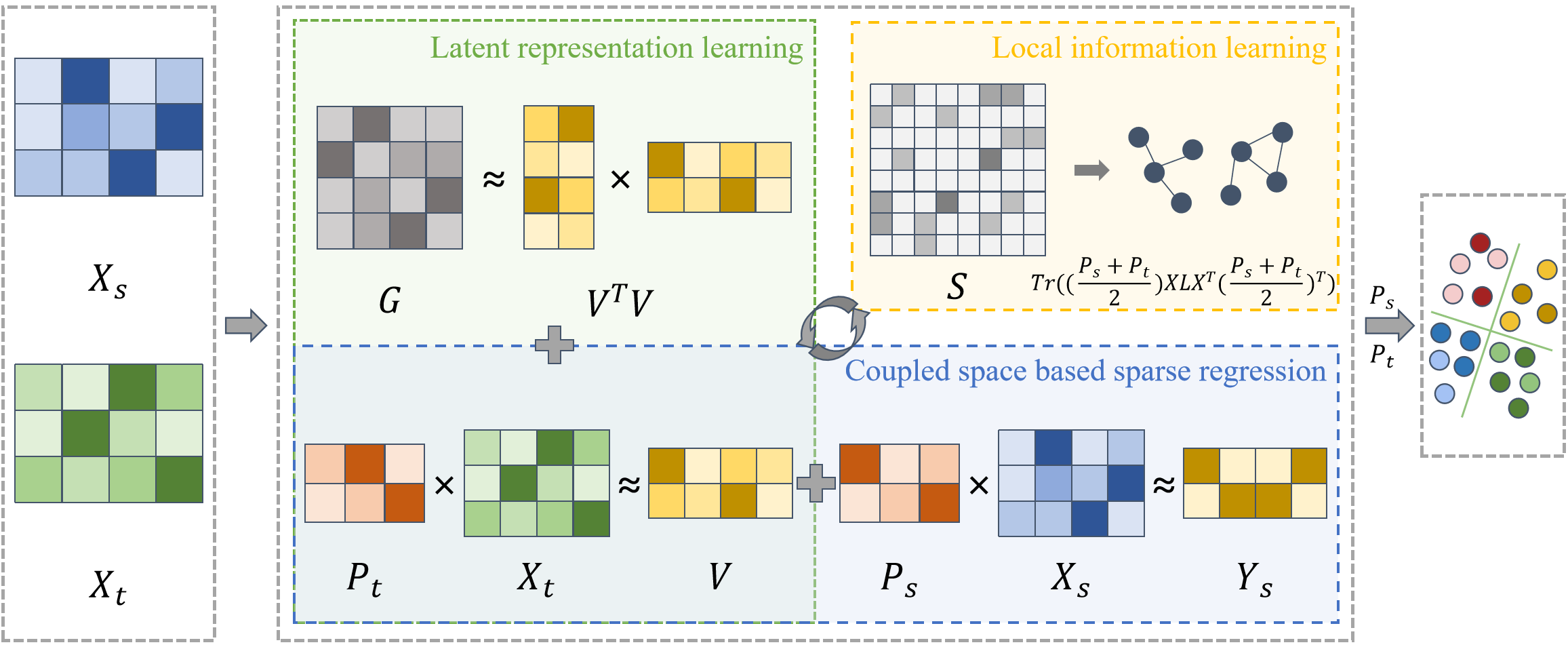
We propose a novel DA approach named coupled sparse subspace alignment (CSSA) for cross-domain SER. Specifically, CSSA first performs latent representation learning on the unlabeled target domain data, in which the latent representation matrix is then optimized into a pseudolabel matrix to provide emotional guidance. Meanwhile, it models the source and target domains separately by sparse regression, thereby learning both discriminative and domain-specific information. Subsequently, CSSA performs coupled subspace alignment to reduce the domain discrepancy, where the dual projection matrices are progressively aligned to enhance their similarity. Additionally, a graph Laplacian regularization is applied to the cross-domain data to capture the local geometric structure.
Coupled Sparse Subspace Alignment-Based Domain Adaptation for Speech Emotion Recognition
Siqi Fu, Peng Song, Wenming Zheng
IEEE Transactions on Computational Social Systems (TCSS) 2025
We propose a novel DA approach named coupled sparse subspace alignment (CSSA) for cross-domain SER. Specifically, CSSA first performs latent representation learning on the unlabeled target domain data, in which the latent representation matrix is then optimized into a pseudolabel matrix to provide emotional guidance. Meanwhile, it models the source and target domains separately by sparse regression, thereby learning both discriminative and domain-specific information. Subsequently, CSSA performs coupled subspace alignment to reduce the domain discrepancy, where the dual projection matrices are progressively aligned to enhance their similarity. Additionally, a graph Laplacian regularization is applied to the cross-domain data to capture the local geometric structure.
2024
Common Discriminative Latent Space Learning for Cross-Domain Speech Emotion Recognition
Siqi Fu, Peng Song, Hao Wang, Zhaowei Liu, Wenming Zheng
IEEE Transactions on Computational Social Systems (TCSS) 2024
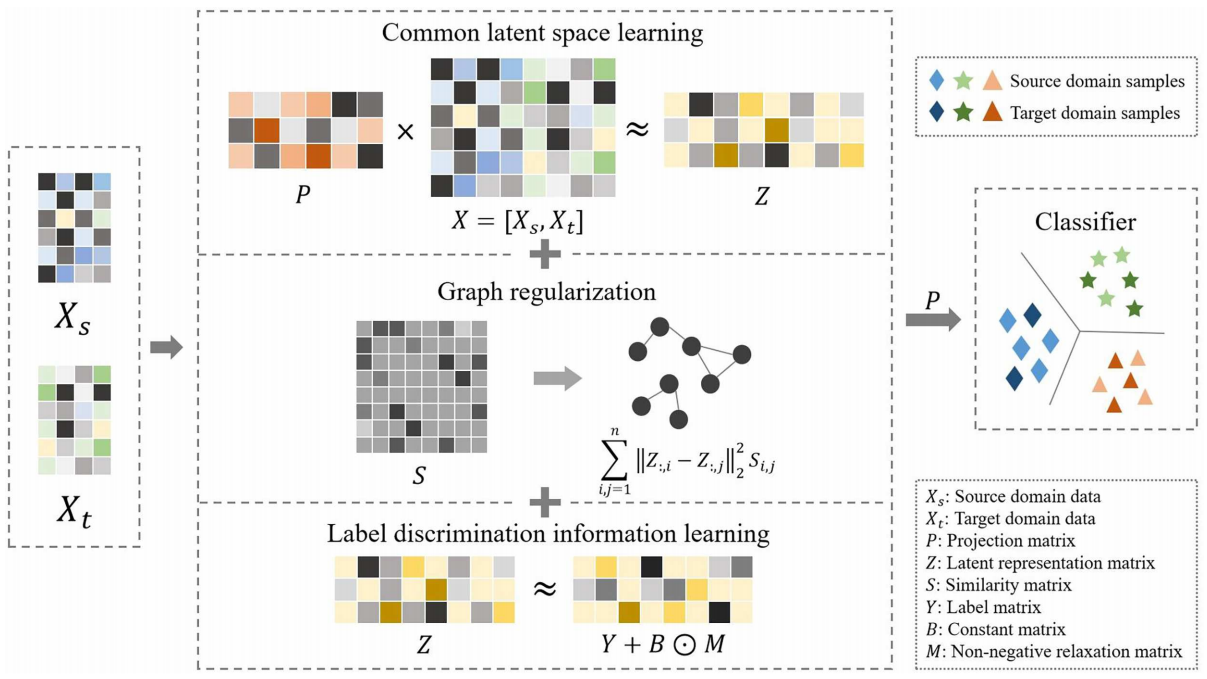
We present a novel common discriminative latent space learning (CDLSL) method for cross-domain SER. To be specific, we first obtain a common latent space by imposing a projection matrix on the cross-domain data. Meanwhile, we impose an uncorrelated constraint on the projection matrix to ensure that the features are representative and discriminative after dimension reduction. Then, we implement a graph regularization term on the latent representations of the samples to capture the local similarity information. Furthermore, to obtain a more discriminative common latent space, we introduce the label information by aligning the latent space with the relaxed label space, while mitigating the information loss for regression.
Common Discriminative Latent Space Learning for Cross-Domain Speech Emotion Recognition
Siqi Fu, Peng Song, Hao Wang, Zhaowei Liu, Wenming Zheng
IEEE Transactions on Computational Social Systems (TCSS) 2024
We present a novel common discriminative latent space learning (CDLSL) method for cross-domain SER. To be specific, we first obtain a common latent space by imposing a projection matrix on the cross-domain data. Meanwhile, we impose an uncorrelated constraint on the projection matrix to ensure that the features are representative and discriminative after dimension reduction. Then, we implement a graph regularization term on the latent representations of the samples to capture the local similarity information. Furthermore, to obtain a more discriminative common latent space, we introduce the label information by aligning the latent space with the relaxed label space, while mitigating the information loss for regression.